The spiritual potential of MRI
Words by Clayton Mellina
At 9:30am on a still-overcast Monday morning in Redwood City, I'm exhausted as I navigate to my car in the parking lot of the Stanford Medicine Outpatient Center. I've just emerged from my annual pilgrimage to the radiology clinic for a yearly MRI scan, still a bit hazy from the experience, and starting to pull together the threads of the otherwise normal day I'm starting. For over a decade, I have made this pilgrimage for a brain and spine MRI "W AND WO CONTRAST" as it's written on the imaging order from my doctor's office, meaning that part of the scan should be conducted with a contrast agent administered to me by IV (the "W" part), but only after the part of the scan without the contrast (the "WO" part). Combined, the imaging takes around 90 minutes. It's conducted lying down, yes, but the fatigue I'm shaking off as I get in my car is not from exertion. It's from the total lack thereof: from staying perfectly, effortfully still for that entire time.
I have these yearly scans as part of the routine management of NF2-related schwannomatosis, a rare chronic condition. I'm somewhat unusual in that MRI is normalized for me. Typically someone might have a similar scan in a state of anxiety and uncertainty, to get a diagnosis or triage the damage after an accident. My scan however is routine, just something I have to do, so despite the possibility of it finding some new unpleasant progression of my condition, I am not usually in a state of agitation going into the radiology clinic. Maybe that allows me to be less burdened, a bit more reflective. In any case, what strikes me is that the MRI experience is a ritual that is much more spiritually serious than our culture allows it to feel. It is of course not a supernatural process, but it is, in a sense, yearning to be profound.
That I am this patient, enabled by these financial instruments, meant to be here at this time, in this room now, where "the nurse will be by to see you soon, and in the meantime please change into this hospital gown."
Earlier that morning I had checked into the radiology clinic in a typical bureaucratic exchange. Name, date of birth, insurance card, copay, patient questionnaire. Someone calls me from the waiting room to escort me past the threshold into the clinic itself, down the white hallway, and again they ask my date of birth to confirm. It is, after all, extraordinarily important that the institutional machinery precisely situates me in time, space, and society. That I am this patient, enabled by these financial instruments, meant to be here at this time, in this room now, where "the nurse will be by to see you soon, and in the meantime please change into this hospital gown."
That was the first of my "spiritual guides", a medical assistant, responsible for "rooming" patients like myself. The series of guides that follow lead me, step by step, into a very specific and intense experience, and though they are kind, my interactions are routine and perfunctory. The specificity with which I am identified to strangers I've only just met is a strange beginning to what can only be described as the truly extra-societal experience of a full body MRI.
In the exam room, I put on the patient gown and put my clothes and all my belongings in a locker for after the scan. Another nurse comes by who, in a cordial flurry of pleasantries, inserts an IV in my arm for the contrast. Then I wait, drinking in the sterile surrounds, the lightly textured beige plastic on everything designed to be grasped and the perfectly smooth, alcohol-clean surfaces on everything that's not. One time I put my glasses away in the locker too, but I have blurry enough vision without them that I couldn't read the expectant look of the nurse at the doorway and didn't hear their "follow me" over the background chatter of the clinic, resulting in an awkward moment that, I think, to them seemed as if I was ignoring them, maybe lost in worry as perhaps many patients are in that moment. After that I always keep my glasses on until the very last moment. That moment comes after the imaging technician leads me deeper into the clinic where, right outside the MRI room itself, I finally remove my glasses, giving up my normal sight and surrendering fully to the experience that follows.
But what if we didn't look away? Do we need to? Are there reasons that the aesthetic of routine logistical flow is good for patients? Is there an opportunity to re-enchant the encounter of one's own interiority?
These preparations — getting naked, donning special garments, the slight pain of the IV, the resignation of my sight — almost seem designed for ritualistic gravity if not for the fact that they seem more designed to look away from this gravity, to feel routine. But what if we didn't look away? Do we need to? Are there reasons that the aesthetic of routine logistical flow is good for patients? Is there an opportunity to re-enchant the encounter of one's own interiority?
Michel Foucault's 1963 book The Birth of the Clinic provides one of the relevant intellectual foundations. Foucault describes clinics as spaces designed to strip patients of social context so that they can be perceived by the medical power structure without the noise of a patient's narrative, a phenomenon he termed "medical gaze." In Foucault's account, this reduction of patients to "cases" has a functional role in subjecting the patient to medical authority and establishing a channel of therapeutic manipulation. Of course, the modern clinic that Foucault critiques was itself a sharp departure from the informality of medical practice before its nineteenth century institutional formalization. Prior to the development of scientific medical theory during the Enlightenment, medical practice was often directly religious, and therefore leveraged religious power relationships in establishing therapeutic treatment and ritualistic modes in enacting it. The clinic — as power structure — was required to displace pre-scientific medicine.
There is a diversity of views on how modern clinical aesthetics affect patient experience and outcomes, and this question has been of interest to medicine for quite some time. A common suggestion is that the clinic induces a placebo effect, triggering a conditioned response that has real physiological benefits. The highly competent and professional appearance of the clinic may reduce anxiety. The apparent mundanity of clinical routine gives assurance that your case is, thankfully, unremarkable. Submitting to a depersonalized logistical protocol provides a sort of scaffold for anxiety, allowing you to take a more passive role, relieving you of the need to be in charge, and providing a manageable container for the overwhelming experience of illness. The blankness of the clinic removes cognitive load that may burden a patient in distress, providing a sort of sensory deprivation.
An alternative perspective, often running under the banner of "healing architectures", argues that sterile environments slow recovery, perhaps by actually causing stress. The seminal paper "View through a window may influence recovery from surgery" finds exactly that: patients in a room with a window recover materially faster than those who aren't. Surely, it seems to me, there is some truth in all of these perspectives, and what balance of factors contributes to human wellbeing during what is often the most harrowing experience of modern life — the experience of being a patient — is surely important to understand more deeply.
By the time I enter the MRI room, I have indeed been thoroughly stripped of social context and come ready for magnetic resonance; as literal a "medical gaze" as I can imagine. There it appears: the MRI machine, a toroidal monolith that looks like some sort of alien altar in the center of the slightly dimmed room. The magnetic field it produces would rip any magnetic material out of or away from your body, so you must approach it solely biologically, as I've sworn I am to several of the nurses along the way. I'd lost track of all the turns down the clinic's hallways, but this room is unmistakably the heart of the building, the perceptual core to which all the logistics are designed to convey precious lumps of biology. The clinic's third eye.
I lay down on the patient table that sticks out from the machine like a tongue. The imaging technician hands me ear plugs which I put in, then places foam pads on either side of my head and snaps down a sort of cage over my face, all in service of helping me keep my head still during the scan. I'm given the option for a light blanket, which I always take, and finally handed a rubber bulb attached to a tube that snakes out to some pressure sensor, the only tether remaining to the outside world. I can squeeze this bulb at any time to alert the tech that I need their help for any reason. The asymmetry is amusing: this one bit communication channel is all the bandwidth I'm allotted, while the scan itself generates gigabytes of data. Finally, as I take a few last wiggles to get as comfortable as possible, the table starts to slide, ingesting me into the machine's mouth.
The MRI machine looks like a portal to another dimension, and actually it works sort of like that too. The blank field of white in front of my face is the inner curve of the MRI's torus. It is an abyss that, whether or not you gaze into it, will very much gaze into you; that's why I'm here after all. The center of an MRI machine is a liminal space of experience in which the only viable act is stillness.
The sort of MRI machine I'm lying inside of is top of the line. It likely costs a few million dollars, and the hospital needs to get every penny's worth by tightly scheduling a steady flow of patients. The flow of patients also argues for smooth, easily cleanable surfaces. But unadorned, the plastic surfaces and vinyl floor tiles sterilized by regular coats of antimicrobial cleaners seem just as free of meaning as they are of bacterial colonies.
Ornamentation functions as a sort of adhesive surface on which humans project and attach meaning. Ornamentation on a building, or even the proud lack of ornamentation in favor of the purified geometry of minimalism, provides the loci of our relationship to that building. Buildings I know well and have memories within always seem to safeguard my nostalgia. When I return, I find my recollections stretched across them like a material, preserved and sun-faded, bunched up on the most intricate parts of the facade, at the base of columns, or tucked under eaves.
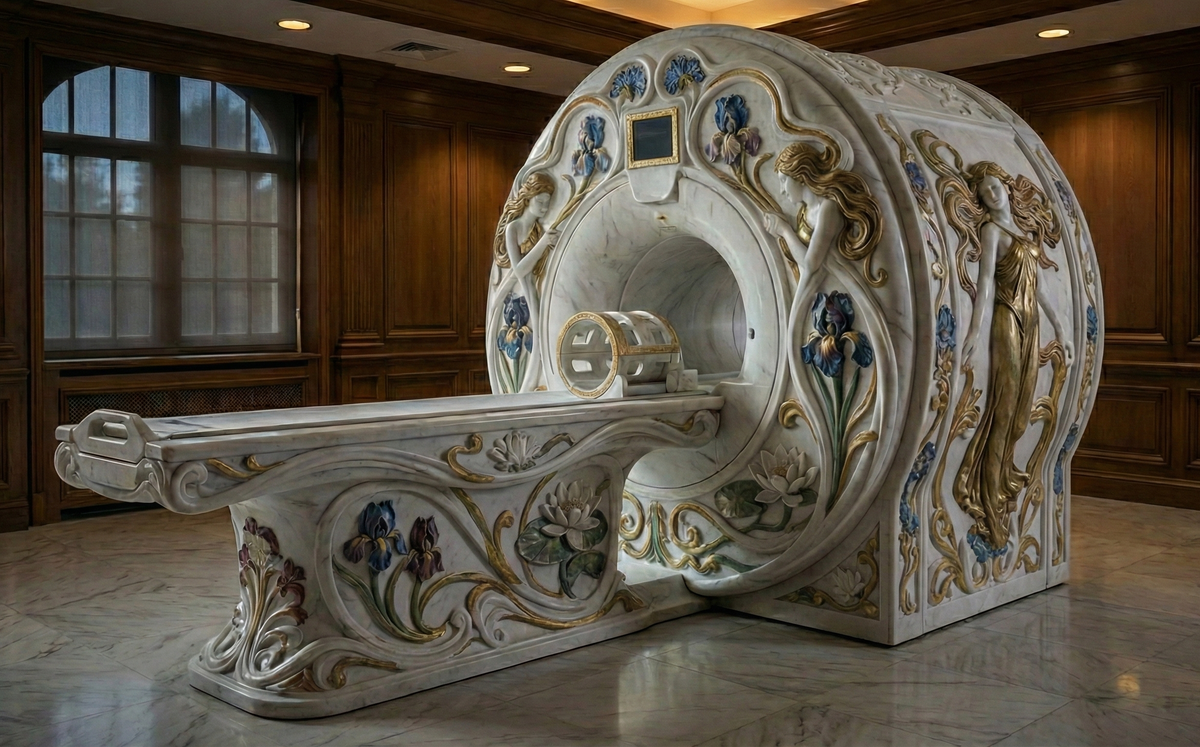
The machine has no such ornamentation, but it presents a powerful geometric statement nonetheless. Some MRIs at children’s hospitals are decorated like cartoon pirate ships or airplanes. I think I’d like something more like carved marble or the mosaic tilework of Alhambra or perhaps Art Nouveau, though I admit that the plain torus has an appeal. Its blankness is maybe a necessary void, forcing my gaze inward, though I can’t help but imagine the torus resplendent with decoration befitting its aura in some way. After all, MRIs themselves help us understand our very own perception of beauty. One study used fMRI to measure brain activity arising in patients looking at buildings of varying visual complexity and found that “fascination”, a factor describing a scene's "informational richness", is tied to specific brain regions. The machine I'm in now could, with the right parameter settings, perform fMRI too. If I were looking at pictures of the Sagrada Família instead of this blank whiteness, this machine could watch my own fascination in my right lingual gyrus, reading my thoughts by detecting which parts of my brain are receiving more blood oxygen, like listening for how hard each little bundle of neurons is breathing in real time as visual information fluxes through them. I'm not here for that, though. Today the machine is configured for a structural MRI tuned to map the distribution of tissues, forming an image of where fat, water, and bone are throughout my head and spine.
I hear a few preparatory clicks and buzzes, and then the scan starts. If you don't know, an MRI machine is loud, and maybe to some that's the worst part, but honestly I kind of like it, or at least I can find enjoyment. It is an otherworldly riff-based jam, repetitive, metallic, maybe lacking some "feel" but not entirely without musical merit, at least if you are partial to early electronic music, odd time signatures, or polyrhythms. Magnetic alien techno djent. The full scan is a series of "sequences", each with a distinct rhythm and timbre that function like tracks on an album, with me the very captive audience of one. Like any album, some sequences are better than others, and some, actually, are real bangers; or at least I pretend so to pass the time. I play along some accompaniments in my head to dress them up a bit, and sometimes achieve something that wouldn't be out of place on a mixtape next to tracks like Autechre's plyPhon or Gantz Graf, which are, for me, classics from my earliest forays into electronic music.
What I'm hearing, actually, is an extraordinary physical process. On this instrument, each riff is a precise sequence of magnetic fluxes and radio pulses. Right now, a magnetic field stronger than any I've ever encountered is permeating my body. Around me, in the torus a foot from my face, is a superconducting magnet, cooled by liquid helium (which itself is sometimes insulated by another layer of liquid nitrogen) to only a few degrees above absolute zero. This magnet creates a smooth magnetic field through me that is almost perfectly uniform in the imaging volume. The spinning single protons in the nuclei of hydrogen atoms (which account for >60% of all atoms in your body) align their axes with the lines of flux, spinning around the axis running from my head to my feet. Each crash of sound is the vibration of the structure around me on which another set of electromagnets are mounted as high current slams through them in precise synchrony. These blasts distort the magnetic field, momentarily forcing protons to spin at slightly different frequencies depending on their location left-to-right across my skull, like tuning each point to its own musical pitch. This tuning step is how each location is "tagged" in a way that later signal processing can decode and map back to spatial coordinates needed to form images of my internals. This is shortly followed by a pulse of radio waves that knocks the protons into a synchronized dance against the magnetic flux. Over the next few moments, the protons slowly realign to the central axis, like water finding its level, spilling the excess energy gained from the radio pulse back to sensors surrounding me. This echo of radio waves is patterned by the spatial distribution of protons, my tissue singing back its structure in the electromagnetic spectrum with each repeating cycle.
Am I not, in this moment, in the presence of something that seems supernatural?
This is perhaps where words fall short. The process is completely natural, no apparent super- involved. Our language hasn't caught up to all the new sources of the profound that suffuse our modern world. But at this moment I am in contact with a process that interacts with the matter of my body in ways that are highly rarefied. It is like the MRI machine is reaching down through the layers of reality, below my biology, below chemistry, through my cells and around all the complex molecular structures that comprise them, down into atomic nuclei, and for short moments, connects them into an aligned unity, a field of protons pointing the same way and resonating with the pulsing torus. Our "spiritual gaze" is often oriented back to our past, but perhaps not gazing enough at our present, or learning how to gaze toward our future, and we need new concepts to help us.
The word I propose is hypernatural: a phenomenon that is simultaneously natural in distinct ways in a rare combination that, perhaps momentarily, connects usually distinct aspects of reality together into a coordinating whole.
The word I propose is hypernatural: a phenomenon that is simultaneously natural in distinct ways in a rare combination that, perhaps momentarily, connects usually distinct aspects of reality together into a coordinating whole. Superconducting magnetism directing atomic nuclei in biological tissue to dance to algorithmic choreography, if it is anything, is hypernatural. And so are many other processes that we've somehow learned to see as mundane, whose functioning we've hidden behind plastic housing, and whose modes of operation we've learned to think of as esoteric, relegated to textbooks or academic specialties. It is all well and good to learn how MRI works, though knowing that in any great detail is beside the point. It's also certainly expected in a sense to appreciate that it exists at all. But there is another way of regarding the hypernatural besides those of understanding and gratitude. We can see it as spiritual, as somehow both a miracle and our destiny, as a way of communing with nature, as a way of making meaning.
Thankfully, the tech announces over the speaker from the outside room that it is time for contrast. That means we're mostly done, just a few more sequences, and I can finally move and stretch. They come in and administer a solution of gadolinium through my IV which functions to enhance the images, like a way to paint my blood vessels, an analogy that is corroborated by the chemical taste that floods up from inside of my tongue. After the scan is done, as I'm walking groggily to my car, I'm thinking ahead a few days to getting the results from my doctor after a radiologist combs through the images.
There is such a distance between the strange experiential sacrament of the MRI and the comparatively normal experience of discussing my health with my doctor. They have such different phenomenology that it's easy to miss that they are transpositions of each other. It's in the doctor’s office where, with images in hand, we can construct the narrative about what these images mean to me and my life, where I voice my desires for myself, and where we redraw the map into the uncertain future. It would seem that this is where meaning is made, and not in the procedural, unornamented clinic, inside that weird and very loud machine that was kind of an inconvenience in the first place.
But in the MRI, I am being perceived not just by the machine alone, but by a technosocial system that is, at least aspirationally, the culmination of humans' striving for holiness, a system of which I am a part, or perhaps more accurately, is a part of me. It is from within the MRI machine that information propagates out of my interior and, later in the doctor's office, back into my mind. The "medical gaze" is in fact my own; my long stillness in the MRI is a way of witnessing myself, and I, for a moment, joined the machine in hypernatural wholeness. We would do well as a culture to design our instruments to reflect their profundity, add more adhesive for meaning making, and pause to view our technological rituals in essentially spiritual ways.
 Substack